
Austen Gaskell #4
Woes & Worries:
A 'Pride & Prejudice' and 'North & South' Variation
by Ney Mitch
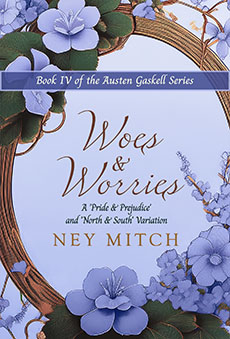 Bessy Higgins is gone, and all those who are left behind are now mourning the loss. Not only has Nicholas lost his beloved daughter, but he is not the only parent to suffer a loss of a child.
The aftermath of the strike has brought more tragedy to the Boucher family, Thornton must recover from Margaret's rejection, and all are trying to cling to the hope that they need to recover. The Bennet sisters, along with Margaret Hale, have many more trials of woes and worries before they are granted their happily ever after. Following the agonies of Bessy's death, it marks only the beginning of more ups and downs, where the ladies not only have to face the pains of their own hearts, but also striving ever onward until they find their happiness.
Here comes the next chapter of the series!
Purchase
Amazon
♥ Smashwords
♥
Nook
♥
Apple
♥
Google Play ♥
Kobo
♥
PRINT
Release Date: September 22, 2025
Genre: Historical Romance | Reimagining
A Pink Satin Romance
Excerpt
Chapter One:
Fate Being Overturned
Smoke...
Always puffing out from the mills and filling the sky with the gray color that it exuded. And that, when synthesized with the natural overcast that comes from sometimes dwelling in the North—gave me a feeling of suffocation.
For what was it but another indication of the despair and confusion that Margaret and I felt from within?
Can one begin and end when in such a state?
The reality came pressing on our hearts and heads as much as it overwhelmed Mary Higgins.
We were not dreaming. No! Rather harsh reality had to come and wake us up from the enthusiastic cloud that had encased Margaret Hale and I a moment ago.
Bessy! Why her?
There she looked, graceful and elegant, with her eyes closed, but it didn’t matter. Must everything forsake us?
Without knowing what I was about, I walked up to her and touched her face, just to make sure.
Her skin was cold, and she did not breathe. I knew. Of course, I had known. But why did I need to confirm it? I suppose, I just wished for a miracle. A miracle that would raise her from her beautiful rest, that would overturn the great envelope that was death, but it was not to be.
There she lay, so far away from us, and without any hope of returning to Milton, where her friends would be, always waiting for a light that had long gone out.
At last, we turned back to Mary Higgins, whose eyes were filled with the emotion that comes from being overcome, but her face was also frozen over from the shock of feeling such a loss.
Margaret walked up to Mary slowly.
“Mary,” she began, opening her arms to her. “I cannot begin to understand what you are feeling.”
“I don’t know,” Mary began to utter, mad from the emotional confusion that was swelling inside of her, “I just don’t know.” She struggled in Margaret’s arms, but at last, she gave way and let Margaret hold her. Weeping into Margaret’s shoulder, Mary began to pour forth her feelings of being both forlorn and giving way to the loss that she now had experienced.
When looking down at Bessy, who never had the chance for the life that she deserved, I wondered if I ever had the right to be happy again. Or if I ever had the right to complain about the small things that tax us all in life. For what were my woes and worries when placed on the great scale of those who now had to walk down the road of the biggest misfortune of all? People view death as a release and not a punishment. Despite that it is perhaps the longest and most inevitable road that we are meant to walk down, I do not agree. I will never agree. Nothing is better than life.
Her eyes were closed.
Never to open again.
Never to look on us.
To see us as we came to visit.
Or to widen when she beheld the books that we had that we could supply her with.
No more would she see any of these sights.
Suddenly, we heard a voice just outside the door.
It was Nicholas!
He was speaking with someone. By the sounds of it, it might have been Plato. They were speaking casually about something—a subject that would be thoroughly upended when Nicholas came walking through the door and the news would have to be given.
I was not prepared for this.
When taking a look at Margaret, her eyes widened with subtle alarm. She was not prepared for this either.
This was going to be terrifying. Absolutely terrifying.
* * *
The seconds felt like an eternity, but the moment came where the door opened, and Nicholas entered.
“It’s cold out there,” Nicholas said, absentmindedly, “like the very devil—”
He cut off his words when he saw us all standing there. Our grief was written across our features, and he halted, not even recalling to close the front door behind him. Between our positions around Bessy’s bed, to seeing Mary’s head resting on Margaret’s shoulder, he froze.
“Ladies,” he said slowly, “what are yer—”
As he took a few steps closer, he saw that we were all huddled over Bessy. When seeing her, he stopped in his tracks.
We all looked at him in agony. Within our eyes was the message: ‘She is not sleeping, Nicholas. You know what you have to face. You know the truth.’
When seeing that look in our eye, he shrunk backwards against the wall.
“No,” he uttered, despair etched across his features. “No.”
“Yes, Nicholas,” I said at last, “we are sorry. We are so very sorry.”
“Save yer sorrys for someone else, lass!” he hissed, moving past us savagely, sitting down next to Bessy’s body and shaking her. “She’s jus’ sleepin’. That’s all there is. Wake up, Bess! Wake up.”
“Nicholas,” Margaret urged, “Mary’s crying. Look at Bessy. She is gone. She is at peace now.”
“Peace,” he cried, “Peace! Who ever said death is peace? Whoever said tha’?”
We were silenced.
“No,” he argued, refusing to see the truth of Bessy’s passing. “I will not have it. She jus’ needs to be shaken awake.” He shook Bessy’s corpse again. “Wake, lass! Wake and don’ leave us here alone!”
“Nicholas,” Margaret urged, “she is gone. She finally has the happiness and freedom that she wanted.”
“Papa, let her go,” Mary wept.
“Let her go?” Nicholas cried, turning on us with a fury. He took two rash steps forward, and I was thunderstruck because I couldn’t tell his intentions. Suddenly, a cry rang behind us and a figure rushed into the doorway.
“Nicholas!” Plato cried, stepping into the house. He must have overheard Nicholas’s outburst and had been listening in the whole time. When Nicholas’s sorrow transformed into fiery passion and rage, he must have felt that it would overcome his logic and reason, and he might become slightly belligerent. Instinctively, Plato came forward and stood in between us and Nicholas. “Save this madness and don’t take your angry words out on them.”
“I...”
“Am heartbroken. They are trying to comfort you, man.” Plato looked over Nicholas’s shoulder and saw Bessy. When his eyes fell on her lifeless figure, his expression slackened and turned to regret. “Oh, Bessy.”
“Don’t tell me she’s dead too,” Nicholas cried, weeping. “Don’t you do it too.”
“I’m sorry,” Plato stated simply, and humbly. Treating Nicholas like the spooked animal that he was, the next words were slow and steady. Plato was trying to be delicate, but what can you say to a man who is so broken that he cannot face reality? “I don’t want to say it, but I must. Bessy... I’m sorry, Nicholas. No father should have to face this.”
“No,” Nicholas wept, “I shouldn’t. I will not and curse any who tells me so!”
Nicholas lunged forward but Plato pushed his hands backwards, grabbed Nicholas’s face and forced him to listen.
“Nicholas, look into my eyes,” Plato urged, “Look at me, man!”
Plato’s sudden physical contact and holding his face surprised Nicholas. And it was no wonder. In a world where man and woman are not allowed to often embrace each other in such a way—in a world of shut-up hearts and coldness—Nicholas was thunderstruck at Plato’s audacity. He had no choice but to look into Plato’s eyes and lose his strength at being touched.
“You are heartbroken, and you are a man,” Plato noted, “you are not allowed to cry. You are not expected to cry. And so that has led to you lashing out in anger, in wrath and ruin, at these ladies. These ladies who are trying to offer you solace. And you repay them with contempt. I will not have you hurt either of these women, out of your grief. I will not have violent words pressed upon them, while they are here to help you.”
“You tell me that my child is gone, Plato,” Nicholas blurted out, forlorn. “You tell me something I cannot forgive you for saying.”
“But you will, because it is time for you to accept that it is well for a man to break. You can cry, Nicholas. Your daughter is gone, you are in despair, and you have much grief inside of you.”
Nicholas was shaking his head at this suggestion. It was almost as if...the idea of being seen weak was too much for his sensibilities.
“Yes, you can,” Plato urged him. “Too many years of being told to not weaken, to not give any sign of sadness and emotion has bested you...as it has bested so many of us men. We are told not to break, not to crack wide open, because if we do, we will never be whole again. Well, I tell you now, that is foolish thinking. By doing that, it leads to us taking our anger out on the wrong person. You were to do such to these ladies, and you and they deserve more than your misguided rage. No. You are heartbroken, and you are dying inside. Let it out, man. No one here is going to judge you. No one is going to mock you. You suffered the worst loss a father could suffer. You are breaking. Break. And don’t be afraid.”
At last, in a burst of release and surrendering to his emotions, Nicholas fell into Plato’s arms, weeping into Plato’s chest.
“There you are,” Plato whispered, empathetic, “Bessy was a great woman. You raised a wonderful daughter. Be proud but be sad. No one has the right to tell you that you have to be anything else. Cry, man. You are still a man while you do it.”
Having permission to do so made Nicholas weep harder into Plato’s shoulder.
While watching both men there, crouched on the floor, with one holding and the other being held, cradled like that of a baby, near Bessy’s deathbed, it was a mesmerizing sight.
“Amazing,” Margaret whispered, “do they look like children to you?”
“Yes,” I agreed. “They are boys. Just mere boys.”
After this lasted for a minute, Plato turned and looked up at us.
“He is ready now,” he assured us, “he can take your words and feel comfort from it.”
How did Plato know? How did he know what was in Nicholas’s heart?
Margaret released Mary, who went up to her father and wrapped her arms around his shoulders.
“Papa,” she uttered, “oh, Papa!”
Nicholas held her and thus, Plato was released from his clutches. Walking up to us, Plato’s eyes were soft.
“Go to him,” he whispered, “he’s had his cry out. He will be kind.”
Knowing we could trust him, we walked up to Nicholas and crouched down near him.
“Nicholas,” Margaret assured him, “Bessy was always looking for the kingdom of heaven. She has found it. Be happy knowing she is there. For she deserved it.”
“She worked herself like a dog all her life,” he uttered, “never knowing happiness. Why will neither of my girls ever know happiness and peace on earth? Why must they die to get it? It’s not fair, Margaret and Lizzy. It’s not fair, I tell yer.”
“I know it’s not,” I said, looking at Bessy, “we will see her again.”
“I want to see her now.” He sighed, “I want to see her now. No man should have to bury their child.”
We sat with him for a little longer before we realized that he needed to be alone.
Returning to our home, we told those who were there about what happened. By the end of the night, the whole street learned of Bessy’s passing.
After eating, and taking some of our dinner to the Higginses, Plato was going to escort his sister back to her house. Before they did, I could not help but ask.
“How did he know?” I asked Raspberry about her brother, “how did your brother know that Nicholas’s violent temper was a reaction to being unable to cry? Is it because they are men, and it is a language that they know between them?”
“Possibly, yes,” Rasby replied, “when growing up, our mother had a saying. She said that we humans are like branches on a tree of life. Men are the sturdy and stronger branches, and we women are the thinner branches that give way in the wind. If you try and sit on us, we give way and might even break a little. But men can weather it. However, when a storm comes, a true storm of epic proportion, the thinner branches survive the most, because they give way in the wind. But the sturdy branches break because they are not used to giving way. So, when they break, it is the hardest. Nicholas, like many men, is that sturdy branch. And he just walked into the worst storm of all. Plato was raised to know this. Besides, he went through it as well, so maybe it’s also experience.”
“Who died and left him behind?”
“Our mother,” Raspy said, matter-of-factually, and I felt foolish.
“Oh, of course.”
“Don’t you know how that feels?”
“Yes,” I said, “yes, I do. We’re all children, in the end, I suppose.”
“Some say that we don’t fully grow up until we die. I hope that isn’t true. Then again, who knows? Poor Nicholas. Bessy deserved better.”
“Many of us do. But she did, above all.”
She and her brother departed, and I went about my evening. That is the way of humanity, isn’t it?
Someone close to you dies.
You make dinner.
You see them after their final hour had come.
You take a bath.
You know that when you wake up again, they will not be there.
You put your hair up so that it will be arranged for the next morning.
You know that they died in their sleep.
You lay in bed and close your eyes.
And then it comes to you! It all comes rushing back. Only then do you realize what you have seen.
The emotions rush to you in quick succession.
And there, in my bed, did I fully cry. Bessy, why did it have to be you?