
Austen Gaskell #6
Economy & Ever After
A 'Pride & Prejudice' and 'North & South' Variation
by Ney Mitch
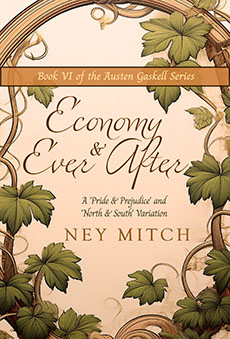 The final chapter of the series has arrived!
The triple marriage has just ended, and the happy couples have every means to enjoy their honeymoon, but there is always some crisis on the horizon.
First, they must return to Hertfordshire to inquire after Mary and confront Mr. Collins. They go to The Isle of Wight, on holiday, to celebrate briefly before they go to Pemberley, and Frederick Hale returns to Cadiz, Spain, to his wife. However, a crisis occurs that they could not have foreseen. As are customary, the complications spiral, and the happy honeymoon finds itself in the middle of a catastrophe.
Follow the adventure of the happy couples, and one more couple that still must be formed.
Purchase
Amazon
♥ Smashwords
♥
Nook
♥
Apple
♥
Google Play ♥
Kobo
Coming Soon in Print
Release Date: February 9, 2026
Genre: Historical Romance | Reimagining
A Pink Satin Romance
Excerpt
Chapter One
Church Bells
With some, they say that a kiss is just a kiss, while a smile is merely a smile.
But with marriage, a kiss is the beginning of everything and anything. All is possible. All is both exhilarating and daunting. With marriage, so much is left to the wayside of the unknown, but that was not what I was frightened of.
When I was blessed with hearing that Darcy, Bingley, and Colonel Fitzwilliam would now be the blessed husbands to my sisters and I, the daunting emotion still hung there, and I could not wait to tell Mr. Darcy of it.
However, such talks of trepidation were not for the moment.
“Come,” Jane said, truly exhilarated, as Mr. Bingley’s arm was wrapped in hers. In her face was the glow of being in love, which made her beauty even more pronounced. “We have an arch to walk under.”
“I am for it,” Kitty said, laughing as she talked. “Now, who shall do it faster?”
“Jane is the eldest, beloved,” Colonel Fitzwilliam said, pressing his cheek against hers, being wholly not serious.
“And I would hate to think that I married a man who cannot tell when I am talking in jest,” Kitty responded. “What sort of man did I marry?”
“One who must always be reminded of his wife’s lighter side, to compliment my darker element.”
“You have a darker element?” Kitty asked. “When did you develop that side of yourself?”
“Between running to the church doors and now. I develop fast.”
Amused, I looked at Mr. Darcy.
“Oh, aren’t our siblings so adorable, Mr. Darcy?”
“Yes, they are, Mrs. Darcy. Yes, they are.”
As we walked down the aisle, I passed Margaret Hale, reached out my arm, out of solidarity. She clasped hands with me, before she smiled, excused herself and ran out of the church to assist with the laurel arch.
“You called me Mrs. Darcy?” I uttered.
“Yes,” Mr. Darcy replied, chuckling as he took my hand fondly, “I did. And I am about to do it again.”
“Good. I was meaning for you to repeat yourself. I don’t think that I would have forgiven you if you did not.”
“Mrs. Darcy.”
I chuckled.
“Again, sir.”
“Mrs. Darcy.”
“Once more.”
“Mrs. Darcy.”
“Now, I am satisfied.”
“You take pleasure in taking up my name.”
“Was there any doubt?”
Mr. Darcy’s eyes twinkled.
“No, I am happy that there had not been.”
When we exited the church, Margaret Hale and Georgiana held up the Laurel arch for us.
Being the eldest Bennet sister, Jane and Mr. Bingley stepped under it first.
Next, I passed under it with Mr. Darcy.
And Kitty, being the youngest, passed under it with Colonel Fitzwilliam. When she did so, she kissed Georgiana on the cheek. This sudden act of affection startled Georgiana, but it was not unwanted.
“Do not fear, Miss Darcy,” Kitty said, “affection is just my way. I cannot adhere to Victorian coldness. It is not my habit.” As she passed along, she shouted over her shoulder. “One day, you might even grow accustomed to my way of being!”
Georgiana chuckled and looked at Margaret Hale.
“I do like open people,” Georgiana said to her.
“It took me time to grow accustomed to people of an open nature myself,” Margaret Hale said, “for a long time, I did not favor their emotional displays. But time might have proved me in error on that matter.”
“Time always tells, Miss Hale. It always does.”
* * *
When we all fully exited the church and went towards our carriages, Jane, Kitty, and I stood side by side, then we turned around and breathed in.
“On the count of three,” I said. “One, two, three!”
All three of us threw our bouquets over our heads.
When we heard the cries of exhilaration, we turned around to see who caught our catches.
The first was Georgiana who raised up her bouquet, her hand above her head.
“I found my path to a bouquet, it seems,” she said. That bouquet was Kitty’s that she had caught.
Jane’s bouquet was to the Tomlinsons, a family that Lady Catherine had strong-armed into attending our ceremony, despite their small acquaintance with us. The humor of that situation was that a lady was not the one who caught it. Rather, it was their eldest son, Mr. Jeffrey Tomlinson, who accidentally, and instinctively, seized the flowers. For a second, his face was lit with surprise. The next second, it shifted to utter terror. His face was overcome with fright, between the embarrassment, and the fact that, from the little I knew of him, marriage was the last thing on his mind. Ergo, he quickly thrust the flowers to his little sister—who was nine years old.
Happily, she took the bouquet and held it to her chest. This led to everyone laughing, and Mr. Tomlinson did not escape humiliation that he tried to avoid. Rather, he was still in the very center of it all. And he didn’t like it by any means.
“He does not take to unwanted attention very well, does he?” I whispered to Mr. Darcy. “An older man at ease would have rolled his shoulders and laughed with the rest of the set. Rather, Jeffrey Tomlinson rolled his eyes, and the mortification hangs about his shoulders like a cross to be born.”
“Oh, are you putting him on the sharper side of your wit?”
“Is this where you are out of sorts with me for making someone the sport of a joke?”
“No,” he said, offering me his hand as he placed me into the carriage. “Here is where I smirk at it.”
“Very good, sir. That is the right answer. Now, who caught mine?”
I searched around to see who could have been the eager one to hold my bouquet in their hands. Naturally, I did not have far to look, but I also should not have assumed it in any other way.
There, in the middle of the attendees, Margaret Hale stood there, awkwardly with the bouquet in her hands.
“Of course,” I said.
“Of course, what, Elizabeth?” Mr. Darcy said, following my gaze. His expression softened as well. “Oh, well now is that not the proverbial image to interest all?”
When seeing us looking at her, Margaret shrugged, a little anxious. She had not intended to catch the bouquet and evidently dreaded the remarks of those around her. But catch it, she did.
“No regret, Margaret,” I said to her.
She sighed.
Sitting down in the coach, I looked at Mr. Darcy, enjoying that the weather was warm and congenial on our most beautiful day.
“Do you know,” I remarked, “I have stumbled on a most happy thought.”
“What?” Mr. Darcy asked, amused.
“I think that I wish to kiss you again.”
“Curious.”
“What is?”
“I was thinking precisely the same thing.”
“Great minds think...”
“Yes, they most certainly do.”
Leaning forward, we kissed again. This kiss was even deeper than the one before. It was heavenly.1
* * *
As we rode back to Rosings Park, I rested my head along Mr. Darcy’s chest, with his arm draped over my shoulder, to maintain my closeness to him.
“Now, I can hold you whenever and wherever I wish,” Mr. Darcy said, “within reason, of course.”
“Yes, Mr. Darcy, within reason.”
“You are about to mock my choice of words.”
“Your words were correct, possessed logic and restraint. After all, we cannot impose too much on the world, can we?”
“No, we cannot.”
I looked at him and smiled.
“Oh, perhaps I was about to mock your choice of words a little.”
“I knew it!”
“You actually know the woman that you married? How unique.”
“Unique?”
“Not all men and women know each other when they marry. There will always be a little taking in, especially regarding marriage. Yet with us, that is not so. You and I have displayed the better and blunt sides of ourselves to such a feverish pitch, that I doubt that we are even unaware of the childhood illnesses that we once had.”
“We do come to the marriage complete. And we have already suffered the worst sides of an argument, and the better sides of overcoming such debates, therefore, there is nothing left to fear. I welcome that.”
“Oh, there was something to fear. But not that aspect.”
“What is this fear?”
“It is a fear that I possess, but you may not share. With marriage, the second one enters it, it can be supposed that one’s cares are over. But sometimes, it feels as if another set of cares has already begun. What if one is ill-prepared for being a mother? What if one is even unable to be a mother? Such things have been known to happen. You worry of not upholding the image that your spouse has of you.”
“Truly? Is this where my Elizabeth shows that there are some things that even her courage cannot get the better of?”
“Yes,” I replied, sighing, “there. This is my confession on my wedding day. Do you laugh at me in turn? You have my permission to.”
“I do not laugh, because nothing in life has any business in being too perfect. If one’s spouse is always ideal, then it forces the other one to feel as if one is inferior for not living up to such perfection.”
“What a wonderfully logical thing to say. I am glad that we are of the same mind on that score.”
“Are we?”
“Of course, we are. For if one is always entirely agreeable, then it forces the other to be such as well—at all times. Well, sometimes, I like to run about the grounds, unleashing my frustration on the world, or sighing at the boredom and dullness of life. If you didn’t moan about some matters occasionally, I would feel alone in my flawed state. And misery loves company, doesn’t it?”
“Yes, very much so. I love how we can talk so much and say so little simultaneously.”
“It is an acquired skill.”
“Yes, it is.”
Mr. Darcy took my hand.
“Do not be afraid. Ever again, Lizzy. Finding you has been one of the best moments of my life.”
“And finding you has been the greatest moment of mine.”
“When we go to Pemberley, you shall want for nothing.”
“Here is the strangest thing. Whenever I think of this grand estate of yours, of this Pemberley and all the grandeur of its reputation, I often forget it to be a Northern estate.”
“It is natural. Everything about my character, from my time being educated in my life, is often spent in the South. I was educated in the South, spent much of my time at Rosings Park and at our London townhouse, and I was even born in the South.”
“You were?”
“Yes. My mother traveled to Rosings Park during her laying in, so that she could be closer to her sister, Lady Catherine. I was born in Rosings Park, actually. And I remained there for the first two years of my life. It was not till after I was three that my mother felt it safe to move me back home.”
“Truly?” I asked, amazed. “And I still have the pleasure of learning more of the man you are.”
“And I think that signified the man that I have become, I cannot help but wonder. I do believe that Southern style of slow life had injected itself into my whole existence. Between that, the constant visits to Rosings throughout my childhood, being at school in the South, as well as usually being at my London townhouse and my social sphere being among Southern society, I rarely act like the Northern man. Sometimes, even I forget that I am a child of both worlds. Besides, my mother is a Southern lady, and father did everything in his power to raise me to that aspect of the aristocracy. And, with the way that Pemberley is established, it is a slice of the South in the North. You will see it soon, and you will judge for yourself.”
“Yes,” I laughed, “because I married you for your house. Of course, I did.”
He chuckled and kissed my forehead.
“No, truly,” I remarked, as a joke, “your character had nothing to do with the matter of settlement at all. Not in the slightest.”
We arrived at Rosings Park, where Lady Catherine had a dinner waiting for us, along with some other local families who were invited.
“You were married at the same house from which you were born in,” I said as we passed under Rosings Parks’ entranceway. “What does that feel like?”
“As if everything has reached a completion. Do I sound odd?”
“You sound like a man who has just gotten married. ‘Odd’ makes sense.”
1. Tossing the bouquet after the wedding was customary in the 1800s, but it was a tradition that actually was created many centuries before.